News
B&L Research Project featured on PLanet Earth Online Podcast -
Dr Emma Stone conducted a podcast interview to raise awareness of the B&L Project and what we have achieved. Click here to listen to the podcast.(updated 30/07/2012).
One Day Lighting Conference at De Montfort University
A one day lighting conference will be held at De Montfort University on the 20th April 2012. The conference is entitled PLanning, Exterior Lighting and the Environment and has been organised by the BAA Campaign for Dark Skies. Speakers include representatives from Buglife, Highways Agency, CPRE and IDA. Further information is provided here. Expressions of interest can be made via Martin Morgan-Taylor at mart@dmu.ac.uk. (updated 30/03/2012).
LEDs paper accepted in GLobal Change Biology
The results of our study assessing the impact of LED street lights on bats has just been accepted for publication in the peer reviewed journal Global Change Biology (March 2012). Once the paper has been released we will provide a summary of the findings on our research page and post a link on our publications page. (updated 17/03/2012).
 Emma gave a talk about the results of the B&L project at Cleeve Village Hall on May 21st to the members of the Campaign to Protect Rural England. The CPRE are campaigning for control of light pollution at local and governmental level, find out more about their campaign for dark skies here (updated 24/05/11).
B&L Project was at the 2011 Festival of Nature
 The B&L project hosted a stall again at the festival of nature in June 2011.
The Festival of Nature is the biggest event of its kind in the UK celebrating the natural
The B&L project hosted a stall again at the festival of nature in June 2011.
The Festival of Nature is the biggest event of its kind in the UK celebrating the natural  world with a vast array of interactive activities, talks, screenings, and workshops. We had a fantastic time discussing bats and lighting with the public, click here to
see what we got up to and find out more about the festival here (updated 22/12/11).
world with a vast array of interactive activities, talks, screenings, and workshops. We had a fantastic time discussing bats and lighting with the public, click here to
see what we got up to and find out more about the festival here (updated 22/12/11).
One World Wildlife has pledged more support to the Bats and Lighting Project
 One World Wildlife (OWW) has stepped in to support the project once again. OWW has pledged a generous grant to assist the B&L Project produce the Bats and Lighting Guidance Document which is being written in collaboration with The Countryside Council for Wales, Natural England, The Bat Conservation Trust, Tom Webster from DW Windsor and ARUP. OWW was one of our first supporters and we are very grateful for their continued commitment to the project and assistance in achieving our aims. Find about more about OWW and the other great projects they support here (updated 10/1/11).
2011-2012 is the Year of the Bat
 The UNEP Convention on Migratory Species (CMS) and The Agreement on the Conservation of Populations of European Bats (EUROBATS) have joined together to celebrate the Year of the Bat 2011-2012. Click here to find out more about these facinating creatures and the year of the bat campaign (updated 10/12/10).
Emma Stone was been awarded the Vincent Weir Scientific Award, June 2010.
The Vincent Wier Scientific Award aims to reward and encourage research on the conservation biology of bats by young researchers. It is awarded annually to a student at a UK-based institution who has made a significant contribution to the conservation biology of bats. Emma has been awarded the prize for her research on bats and lighting!
The bats and lighting project has recently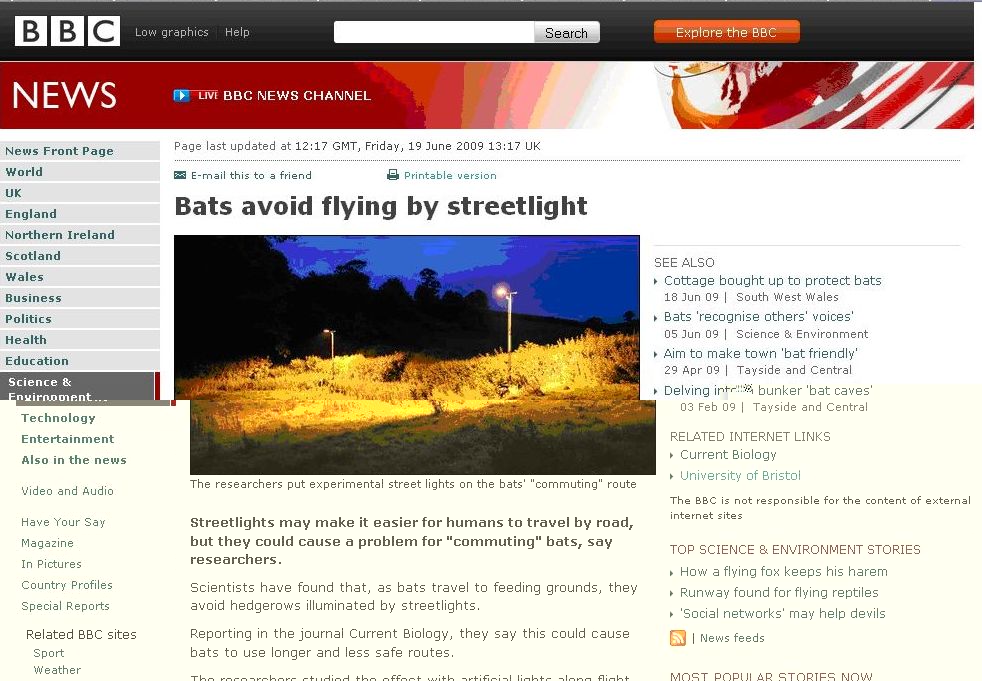 been covered by BBC news online!.Read the article here
New IDA Press Release: Blue/White Light Threatens Animals and People. The International Dark Sky Association (IDA) has issued a press release about the negative impacts of Bluish/White LED and induction lamps.They state that these lights have significant environmental impacts and urge light developers to limit blue light to wavelengths shorter than 500nm. Click here to see the full press release.
Ever wandered how lesser horseshoe bats gave birth, check out this amazing footage!